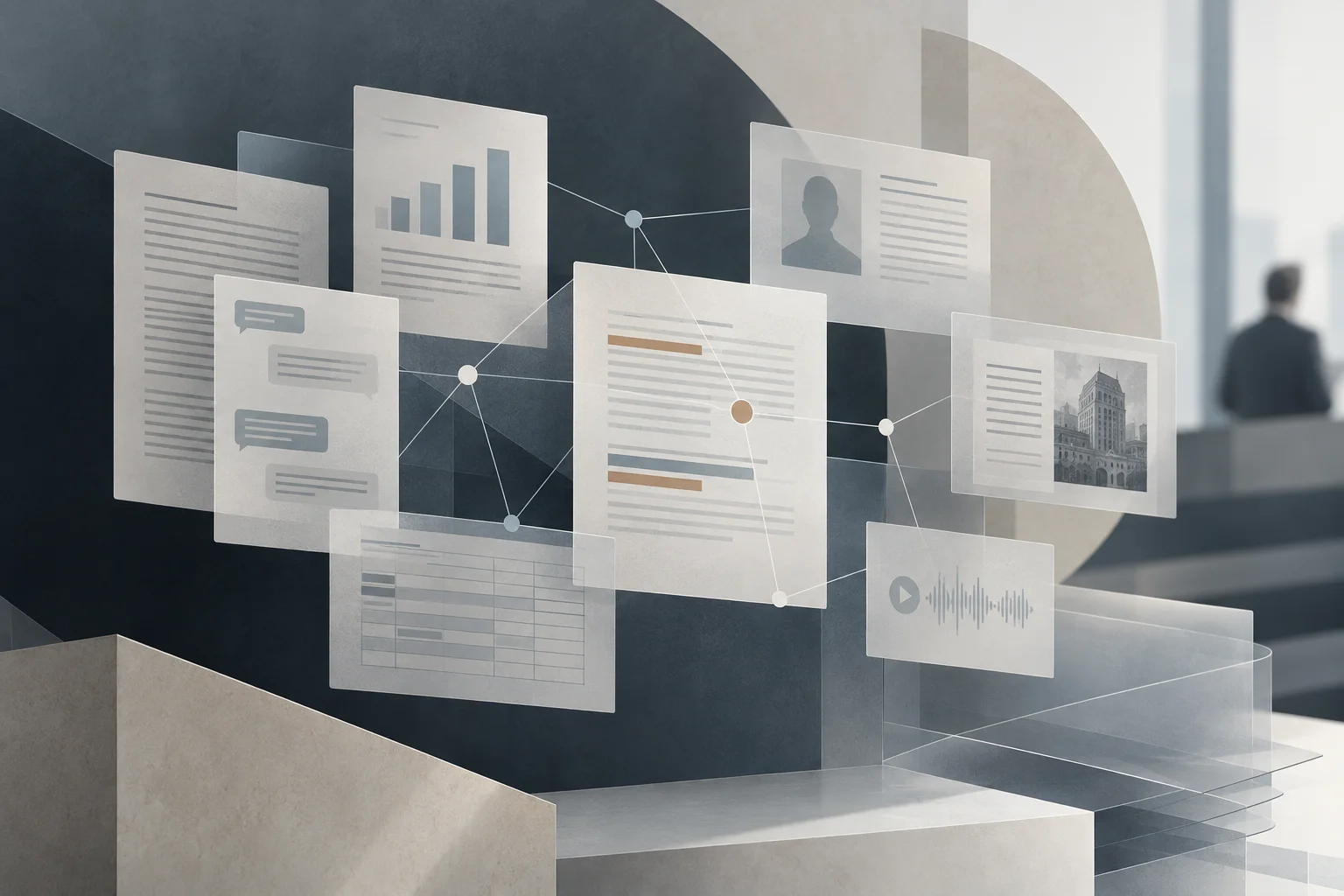

In a commercial case of any size, getting the production is seldom the hard part. Understanding what it says is. A trial team may receive several hundred thousand emails, chat exports from Slack or Microsoft Teams, spreadsheets of transactional data, and calendar entries, and still go into the first Rule 30(b)(6) deposition with only a partial picture of who knew what and when. Review protocols that tag documents as responsive, privileged, or significant answer a production question. They do not, by themselves, produce an account of the case. Artificial intelligence is now offered as the way to close that gap, and the offer deserves both a fair hearing and close scrutiny.
This post argues that AI tools are most useful in large matters when they help attorneys build the factual structure of a case: chronologies, maps of the people and entities involved, and threads of communication that cross platforms. Treated simply as a faster form of document review, they deliver considerably less. That structural use is real and increasingly practical. It does not end information overload in any literal sense, however. What it changes is where attorney attention goes, and the lawyer remains responsible for every conclusion drawn from what the software surfaces.
Large matters strain comprehension more than review capacity
The volume of electronically stored information in ordinary commercial disputes has outgrown the capacity of any team to read it directly. A single custodian's mailbox over a two-year period can contain tens of thousands of messages, and modern productions add chat platforms, shared-drive version histories, text messages, and structured data from accounting or customer-relationship systems [citation needed]. Rule 26(b)(1) confines discovery to nonprivileged matter relevant to a claim or defense and proportional to the needs of the case, and negotiations at the Rule 26(f) conference can narrow custodians, date ranges, and sources. Even a well-negotiated scope leaves the receiving party with far more material than the trial team can absorb. The limit that matters most is how quickly a small group of lawyers can form an accurate, testable view of what happened, and coding speed only partly addresses it.
A hypothetical matter shows how this plays out. In Meridian Analytics, Inc. v. Halvorsen Data Partners, LLC, an invented case used here only for illustration, Meridian alleges that Halvorsen exceeded the scope of a data licensing agreement by reselling licensed datasets to a competitor. Halvorsen responds that the disputed uses were authorized in a later email exchange between the parties' account managers. Assume the combined productions total roughly 1.2 million documents, including email, Teams messages, invoices, the licensing agreement and its amendments, and server access logs recording when files were downloaded. The questions that will decide the case are narrow (what was authorized, by whom, and when the competitor first received the data), yet the answers sit in formats that a conventional review would route to separate queues and separate reviewers.
Technology-assisted review sorts documents but does not assemble the case
Technology-assisted review, in which a model trained on attorney coding decisions ranks documents by likely responsiveness, has been accepted by a number of federal courts as a reasonable method of meeting discovery obligations [1]. Its contribution is substantial. It reduces the number of documents that require human review, and it gives the producing party a defensible process to describe at the Rule 26(f) conference or in opposing a motion to compel. What it produces, though, is a classification. The output is a set of documents sorted and tagged, and someone must still read that set and turn it into an account of events.
That assembly is where knowledge tends to fragment. A first-level reviewer who reads the March emails between the account managers may never see the April access logs, and the associate drafting the outline for the deposition of Halvorsen's account manager may learn of a contradicting invoice only when opposing counsel marks it as an exhibit. Review memos and hot-document folders try to carry important material upward, but they depend on each reviewer recognizing significance in isolation. Large teams therefore often know a great deal collectively and comparatively little individually. That condition, more than raw volume, is what attorneys usually mean by information overload.
AI can organize the record around people, events, and time
Newer AI tools, including large language models applied to document collections, can be directed at the structure of a case instead of at document-by-document classification. Entity extraction identifies the people, companies, products, and accounts that recur across a collection and resolves variations (a nickname in chat, a full name in an email signature, an employee number in an access log) into a single individual. Chronology functions pull dated events from correspondence, contracts, and logs and place them on a common timeline. Summarization can condense a long email thread or a run of chat messages into a short account, ideally with each statement linked to the document that supports it.
Applied to the Meridian hypothetical, these functions change the first weeks of the case. The team need not wait for review to finish before building a chronology; it can generate a draft timeline that places the account managers' email exchange, the invoice for the disputed resale, and the first download from the competitor's network side by side. If the download predates the alleged authorization, that sequence becomes the center of Meridian's case. A download that follows the email tells Meridian's counsel early that the claim turns on the scope of the email and not its timing. In either event, the lawyers are reasoning from a structured view of the record instead of from whichever documents happened to reach them first.
All of this depends on traceability. A chronology entry or summary that cannot be tied to a specific Bates-numbered document is of little use in a deposition outline or a brief, and it becomes a liability if a lawyer relies on it unchecked. Tools differ considerably in how they handle sourcing. Anyone evaluating a system should ask how each output connects to the underlying record before asking how quickly it runs.
Patterns surfaced by AI are leads that must be verified
AI is also capable of surfacing patterns that are difficult to see from inside a review queue. Examples include a sudden drop in email between two custodians, a shift from company email to a personal messaging app, a cluster of file access at unusual hours, or recurring phrasing that suggests a shared template or a coordinated message. Observations like these can redirect a case. They can also mislead, because the software sees only what was collected and produced. A gap in communications may reflect deletion, a change in role, a narrow collection, or a custodian who began handling matters by phone, and the pattern alone does not distinguish among those explanations.
Generative summaries carry a separate risk. Large language models can state with apparent confidence things the underlying documents do not say, and courts have sanctioned lawyers for filing briefs containing case citations that such tools fabricated [2]. The same failure in a factual summary is harder to catch, since there is no reporter to check, only the documents themselves. Every AI-identified pattern or summary should therefore be treated as a lead to be confirmed before it shapes strategy. At a minimum, verification should include the following steps.
An attorney reads the source documents for any fact that will appear in a pleading, motion, deposition outline, or expert report.
The team checks whether an apparent gap or anomaly reflects collection parameters, such as custodians, date ranges, or sources excluded by agreement at the Rule 26(f) conference.
Someone samples documents the tool did not flag, to test whether its organization has missed relevant material.
A senior lawyer familiar with the record reviews any conclusion that infers knowledge or intent from a pattern.
None of these steps is novel. They are the checks a careful partner would apply to an associate's chronology. The difference is that AI outputs arrive faster and in greater quantity, which creates a temptation to skip verification precisely when volume makes it most necessary.
Existing professional duties govern AI-assisted case analysis
The ethical framework for this work is familiar, though its application to AI is still developing. Comment 8 to ABA Model Rule 1.1 provides that competence includes keeping abreast of the benefits and risks associated with relevant technology, and most states have adopted some version of that comment [3][4]. ABA Model Rule 1.6 requires reasonable efforts to prevent unauthorized disclosure of client information, which bears directly on where a vendor processes a production and whether client data may be used to train its models [5]. Under ABA Model Rule 5.3, lawyers must supervise nonlawyer assistance, and the ABA has issued a formal opinion applying these duties to generative AI [5]. State bar guidance varies [citation needed].
Procedural rules impose parallel obligations. A lawyer who signs a discovery response certifies under Rule 26(g) that it is complete and correct after a reasonable inquiry, and Rule 11 requires that factual contentions in pleadings and motions have evidentiary support. An AI-generated chronology does not satisfy either inquiry on its own. Some courts have also adopted standing orders requiring disclosure or certification of AI use in filings, so counsel should check local rules and chambers practices in each matter [5][6].
Firms should judge these tools by the quality of the early case theory
For firms deciding how to adopt AI in litigation, the most useful measure is how early and how accurately the trial team can state its theory of the facts; review throughput is a secondary concern. A practical test is whether, shortly after the first substantial production, the team can produce a sourced chronology and a list of principal witnesses that a partner would rely on in preparing for a deposition. That standard keeps attention on comprehension, and it builds in the verification discipline described above. One question remains open: whether the prompts, intermediate analyses, and AI-generated summaries a team creates are protected as work product, and when an adversary might obtain them. The answer is unsettled and may vary by jurisdiction [7], so lawyers designing these workflows should assume that the record of how they used the tools could itself become a subject of discovery.
References
Rio Tinto PLC v. Vale S.A., 306 F.R.D. 125, 127 (S.D.N.Y. 2015) https://www.courtlistener.com/opinion/8788861/rio-tinto-plc-v-vale-sa/
Mata v. Avianca, Inc., No. 22-cv-1461 (PKC), slip op. at 1 (S.D.N.Y. June 22, 2023). Secondary sources give the reporter citation as 678 F. Supp. 3d 443; check it before publishing. https://www.ctd.uscourts.gov/sites/default/files/Mata-v.-Avianca.pdf
Catherine Whittle Delorey et al., Ways the Model Rules, State Rules, and CLE Ensure Technological Competence, Construction Lawyer (ABA), Spring 2024 https://www.americanbar.org/groups/construction_industry/resources/construction-lawyer/2024-spring/model-rules-state-rules-cle-ensure-technological-competence/
Robert Ambrogi, Tech Competence, LawSites, https://www.lawnext.com/tech-competence (undated) https://www.lawnext.com/tech-competence
ABA Comm. on Ethics & Prof'l Responsibility, Formal Op. 512, at 6 (2024) https://www.lawnext.com/wp-content/uploads/2024/07/aba-formal-opinion-512.pdf
Standing Order Establishing Disclosure and Certification Requirements for Generative Artificial Intelligence ¶ 1 (D.N.M.) (undated) https://www.nmd.uscourts.gov/sites/nmd/files/Standing%20Order%20Regarding%20Use%20of%20Generative%20AI.pdf
Fisher Phillips LLP, Can Your AI Chat History Be Used Against You in a Lawsuit? 5 Practical Takeaways for Employers as Courts Start to Split (Mar. 20, 2026) https://www.fisherphillips.com/en/insights/insights/can-your-ai-chat-history-be-used-against-you-in-a-lawsuit